|
|
Yale University Near East Collectionhttps://www.library.yale.edu/neareast/exhibitions/exhibit20071.html The West African Arabic Manuscript Database (WAAMD)https://waamd.lib.berkeley.edu/home The British Library’s West African manuscripts collectionWest African Arabic Manuscript Databasehttps://westafricancalligraphy.wordpress.com/2015/07/07/west-african-arabic-manuscript-database/ Islamic Manuscript Studieshttps://guides.lib.umich.edu/islamicmsstudies/onlinecatalogues Digital Resources and Projects in Islamic Studieshttps://themaydan.com/2019/01/digital-resources-manuscripts/ Ajamihttps://library.bu.edu/c.php?g=530950&p=3631915 Ajami is a modified Arabic script that has been used for centuries to write many African languages including (but not limited to): Afrikaans (Arabic-Afrikaans), Fula, Hausa, Malagasy, Mandinka, Swahili, Wolof (Wolofal), and Yoruba.
At times, the Islamic world seems worlds away, obscured by clouds of culture, language, and religion. Even more distant is the Islamic world of nine centuries ago, yet a BYU scholar has engineered a team to span the abyss and bring the bright minds of ancient Islam--heretofore incoherent to the Western world--to the forum of modern Western scholarship. The Incoherence of the Philosophers, an 11th-century text, has recently rolled off the presses as the first volume of the Islamic Translation Series. The second follows close behind.
Most of us don't have much trouble with Arabic numerals. We use them every day to count, tell time, or make purchases. Centuries ago they were adopted as the numeric symbols for the English language. Yet for most of us, any knowledge of the exotic Arabic script stops right at the point of recognizing it, the way we can recognize, say, the symbols for Chinese without any idea what they mean. Likewise our knowledge of Arab thought or literature is limited to perhaps the 1,001 tales told by beautiful Scheherezade to save her life in the Arabian Nights or to linking Muhammed with the Qur'an. But beyond Ali Baba or Sinbad or Muhammed, our knowledge of the stories and thought of the Islamic world remains largely obscure. Few writings have been translated. Even fewer were translated well. Western school children know the names of the Greek thinkers Socrates, Plato, and Aristotle. They've learned to link the first with asking questions and drinking hemlock, the second with an ideal form, and the third with a golden mean. Some children even know the names of Confucius or Buddha. But what connection does the average Westerner make with the names al-Ghazali, Averroes, or Avicenna? Even for those of us with a university education, these three eminent Arab thinkers may only be a tabula rasa in the card files of our brains. To the Islamic world, however, these thinkers were among the greatest to ever wrestle with an idea or to question the pur-pose of our existence. When Daniel C. Peterson encountered these names as a graduate student, first at American University in Cairo, in 1978, then at the Center for Arabic Studies Abroad, he was impressed enough that when he began his doctoral work at UCLA in 1982, Islamic philosophy and philosophical theology became his focus. "The problem is that too few translations of Arab or Persian thinkers have been published in English," says Dr. Peterson, now an associate professor of Asian and Near Eastern languages at BYU. Many of the classical thinkers and writers in Arabic or Farsi (Persian) got translated into medieval Latin, but they were hard texts and rarely made it as far as an English rendering. As a result, much of Middle Eastern civilization has remained out of reach of most educators and students in the West. If Professor Peterson has his way, this void is about to be filled. For nearly 10 years he has been piecing together a scaffold on which to erect an extensive publishing edifice. What he envisioned--a series of Islamic works translated into English--is finally becoming a reality. Its official name is the Islamic Translation Series: Philosophy, Theology, and Mysticism--ITS for short. The first volume of the series, The Incoherence of the Philosophers, rolled off the press in October and has met with favorable reviews from scholars at even the most critical levels and at the most respected universities. "What an ambitious project," said Dr.Robert Coote, of the San Francisco Theological Institute and author of numerous books on the Old Testament. "It is a welcome addition to the literature and is an impressive feather in BYU's cap." Harvard professor William Graham, in the Department of Near Eastern Studies, an expert on the Qur'an and Muslim religious philosophy, commented: "I think it's wonderful they're doing this. Al-Ghazali and the others to be included in the series have not enjoyed good translations into English. This could be a very influential work because it will allow so many more readers access to these great classical thinkers, whom Western students only rarely encounter. "It's a commendable project that is being produced by sound scholars with major reputations. I look forward to seeing the entire series." Unlike most projects produced at BYU, this series has no LDS subject, author, nor translator, at least for the initial volumes. The model for Peterson's vision of the series was the Loeb Classical Library, published at Harvard University Press. With translations of all the major literary works of classical civilizations, the Loeb works are printed with the original language and the English translation side-by-side on facing pages, enabling scholars and students access to texts that would be otherwise out of reach. The BYU Islamic Translation Series uses this same format and will be priced well within the range students can afford. "We're pleased to have Parviz Morewedge, of Binghamton University (of the State University of New York) as editor in chief of the series," Peterson explains. "As a scholar and philosopher, Professor Morewedge has not only published extensively, but he is equally well acquainted. He knows all the right people. His networking capabilities are ideal for introducing the series to the academic communities both in the West and the Middle East." As the originator of the project, Peterson serves as the managing editor. His role, in partnership with Morewedge, has been to add to his scaffolding the physical architecture by bringing together two forces--the scholars, editors, and publisher on the one hand and the financial supporters on the other. BYU, the Institute of Global Cultural Studies at Binghamton University, and other scholars and philosophers have formed the academic mortar for cementing in place the fiscal bricks and timber provided generously by Salt Lake philanthropist James L. Sorenson, the BYU capital campaign, and others. The significance of this collection of Arabic and Persian works by Islamic philosophers has been recognized by some of the most prestigious publishers in academia. Edited and produced at BYU, the series will bear the imprimatur of the Brigham Young University Press but will be distributed and marketed by the University of Chicago Press and will appear in its catalog. "For this series to be promoted and marketed by a publisher as respected as Chicago is a high compliment," explains Peterson, "and being in their catalog alone will turn heads." A national promotion of the first volume began with a reception and gala dinner at the Marriott in Washington, D.C., on Feb. 3, 1998, followed by a West Coast event in Los Angeles, on Feb. 11 at the Beverly Wilshire. Specially selected guests were invited to both locations, and limited-edition volumes were presented to ambassadors and community leaders. In Los Angeles, members of a Muslim group known for its good relations with the LDS Church attended. "This kind of thing is the most important work an LDS scholar can do in this field," says Arthur Henry King, a professor emeritus of English at BYU and a renowned Shakespeare scholar. King and Hugh Nibley, two of BYU's most respected thinkers and writers, have both spoken often of the importance of LDS scholars establishing a universe of discourse or common vocabulary between BYU and the greatest institutions of the world. Elder Alexander B. Morrison of the First Quorum of the Seventy was an early supporter of the project. Elder Morrison hopes that the series, and other projects like it, will help to better relations between the Muslim world and the West. Not only will the series deepen Western knowledge and understanding of the rich civilization of Islam, it will send a message of respect from the Latter-day Saints to the worldwide Islamic community. The translator of The Incoherence of the Philosophers is Michael E. Marmura, who chaired the Department of Middle East and Islamic Studies at the University of Toronto, where he taught for 36 years. The Incoherence ranks as one of Islam's most important works by one of its most fascinating thinkers. Abu Hamid Muhammad al-Ghazali was a brilliant scholar of the 11th and 12th centuries, a prodigy who studied the law from youth, earnestly seeking to understand "what is right." Al-Ghazali was so scrupulous a man that he sought certainty, felt he needed to know the truth about life, but was disappointed in the answers offered by the best scientists and philosophers he had read. He felt that anyone who intended to criticize another's position should diligently seek to understand it first--ideally, the critic would understand the position even better than the proponent. Only then would the critic be in a position to criticize solidly and fairly. Al-Ghazali's attack on the limits or weaknesses of the arguments of the best Islamic philosophers resulted in this volume. By his title, The Incoherence of the Philosophers, al-Ghazali refers to their collapse or destruction, because he dismantles their arguments about God, creation, and existence, particularly in their variance with Muslim teachings. He methodically poses 20 problems in their teachings with which he takes issue. A few which might interest LDS readers are: "refuting their doctrine of the world's pre-eternity"; "refuting their statement on the post-eternity of the world"; "their inability to prove the existence of the maker of the world"; or their inability to prove that God does not have a body. "Al-Ghazali is a master of Arabic prose," writes his translator, Professor Marmura. "His style, however, is very personal and highly idiomatic." He adds that al-Ghazali's quarrel with the philosophers is not over their logic, their mathematics, their science or thinking, but with "those of their theories that contravene the principles of religion." Al-Ghazali writes to refute false teachings, not to defend any particular theological doctrine. The affirming of true doctrine was something he would do in a later work, The Principles of Belief, which could become a part of the BYU Islamic Translation Series. Thirteen more volumes of the Islamic Translation Series are in various stages of completion around the world. The second to be published, a collection of essays by Nasr al-Din Tusi, is nearing its publication date in the first quarter of 1998. It's too early to say what place this series may have among the published works of the world's greatest thinkers. What Daniel Peterson hopes is that like other voices from the dust that have come forth in modern times, these works can attest to the truth that "the glory of God is intelligence" and that by sharing genuine expressions of our search for truth, we may each come closer to an understanding of all things and all people. BYU Leads Translation of Great Muslim Works into English Contact: Michael Smart, (801) 378-7320 PROVO, Utah (March 23, 1998) -- Brigham Young University is spearheading the first systematic effort to translate the writings of great Islamic thinkers into English, making works comparable to the Plato's "The Republic" and Aristotle's "Metaphysics" widely accessible for the first time. "We want more people to be able to take advantage of this reservoir of knowledge and expose them to a cultural perspective that was previously unavailable," says Daniel C. Peterson, associate professor of Arabic and managing editor of the "Islamic Translation Series: Philosophy, Theology and Mysticism." "Studies of philosophy omit Islamic contributions because their authors and editors can't read Arabic. To understand Islamic writings you have to invest 10 to 15 years of serious study in the language, but you can go to any bookstore and pick up a paperback copy of Plato." Each book in the series contains the original Arabic or Persian (Farsi) with the English translation on the facing page. Peterson patterned the series after the Harvard University Press's Loeb Classical Library, a collection of dual-language translations of the great Greek and Latin works. "The series will share the tradition of the Loeb books: accurate, solid translations that are widely available," he says. "We hope it will be found on library shelves from Harvard to the Sorbonne to Oxford." It will be well received, says William Graham, chair of Harvard's Department of Near Eastern Languages and Civilizations. He calls BYU's translation series "a very welcome addition to resources for teaching Islamic civilization, and for other disciplines that can use Islamic works as resources. There is a wide market for it." "It is a commendable thing when a university associated with one religious tradition branches out into a translation effort involving another religious tradition," Graham says. Muslim scholars agree. "This is an incredible contribution from BYU to bring out the Muslim heritage," says Shabbir Mansuri, director of the Council on Islamic Education. His Fountain Valley, Calif.-based organization serves as a resource on Muslim history and civilization for American educators. "Dr. Peterson's work is something that benefits us all. This is our [Muslims'] contribution to the larger body of knowledge out there. It will be appreciated by both a Muslim audience and a non-Muslim audience alike. " The curious combination of a university sponsored by The Church of Jesus Christ of Latter-day Saints and a major effort to translate Muslim writings demonstrates BYU's commitment to seeking after all truth, Peterson says.. "This is a gesture of friendship from the university--and the Church--to the Islamic community," he says. "We're saying, 'We respect your culture--there is a lot we can learn, and have learned, from you.' It's a message that has been well received." In February, the university held gatherings in Washington, D.C., and Los Angeles where copies of the first volume, "The Incoherence of the Philosophers," were presented to ambassadors and consuls from predominantly Muslim countries such as Egypt, Jordan and Pakistan. Elder Neal A. Maxwell of the LDS Church's Quorum of the Twelve Apostles accompanied Peterson to Washington, and Elder Jeffrey R. Holland, also of the Quorum of the Twelve, joined him in Los Angeles. In both cities, the Muslim dignitaries expressed appreciation for the translation effort, Peterson says, because "we're not filtering Muslim ideas through a Christian glass. We're taking some of Islam's biggest names and letting them speak for themselves." "Incoherence of the Philosophers" is a criticism of Muslim philosophies by Abu Hamid Muhammed al-Ghazali, who is known as the "second greatest Muslim after Muhammed." While a famous law professor in the 11th and 12th centuries, he began to doubt that he could know anything for certain. His work concludes that relying on feelings and conscience is the only way to discern real truth. The next editions of the series, a collection of essays by ancient philosopher Nasr al-Din Tusi and another work by al- Ghazali, are due this summer. The books are translated by Arabic scholars from around the world, then produced and printed at BYU. They bear the university's name on their spines and are distributed through the University of Chicago Press. Now that BYU has figured out the intricacies of printing Arabic--the language uses cursive-like script and is read from right to left--Peterson sees the series going on indefinitely and plans to widen its scope. "Algebra is an Arabic word," he says, pointing out the heavy influence of ancient Islamic mathematicians and scientists on today's disciplines. Expanding the series to include their works "will broaden out the history of science and mathematics." In addition to its involvement in the translation series, BYU is home to the American Association of Teachers of Arabic, something Peterson credits to a strong Arabic faculty and BYU's Jerusalem Center for Near Eastern Studies. Daniel C. Peterson named BYU CPART Director Contact: Cecelia Fielding, (801) 378-4377 Writer: Hilary Ross, (801) 378-5856 PROVO, Utah (September 21, 1998) -- An associate professor of Islamic studies and Arabic in the Department of Asian and Near Eastern Languages at Brigham Young University has been appointed as director of the Center for the Preservation of Ancient Religious Texts (CPART). Daniel C. Peterson replaces Noel G. Reynolds, who was recently named an associate academic vice president of BYU. Peterson has been a full-time faculty member at BYU since 1986. "I am impressed with the work that CPART has accomplished so far," says Peterson. "I hope that I can help continue that work. CPART is a subsidiary of the Foundation for Ancient Research and Mormon Studies (FARMS), which became affiliated with BYU earlier this year. FARMS created CPART in 1996 to better manage its projects in the area of electronic texts. Since 1991, Peterson has been the managing editor of the Islamic Translation Series published by Brigham Young University Press and distributed by the University of Chicago Press. The recently published first volume in the series has received rave reviews from scholars who study Middle Eastern civilization and from Muslims throughout the world. Peterson will now administer the project under the umbrella of CPART. "I am particularly pleased that the Islamic Translation Series on which I have enjoyed working will now become one of the Center's projects and receive support from the Center's fine staff," Peterson said. Another CPART project is creating digital images of Greek papyri from the sixth-century site of Petra. Until now, suitable images could not be produced because the papyri was burned by fire making some portions difficult to read. CPART's experts read the papyri using sophisticated multispectral scanning techniques. The center's primary purpose is to make ancient religious texts more readily available to scholars for study. CPART focuses on preserving and improving access to documents that are important for understanding the world's religious heritage. Interpretation of these texts is left to other scholars. Those efforts began in 1993 with a project jointly sponsored by FARMS and BYU to create an electronic database of texts and images from the Dead Sea Scrolls. This database has been hailed by scholars working on translating the scrolls as a major tool for improving their work. FARMS was later asked to direct or participate in similar projects involving other ancient texts. FARMS has assisted in the digital imaging and storing of ancient Maya murals from the site of Bonampak and has been given custodianship of ancient Syriac documents. |
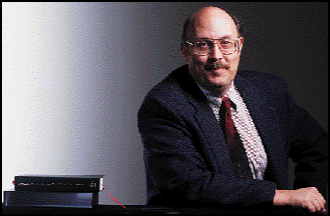 News on BYU's Islamic Translation Series
 PROMOTING LANGUAGE & STUDYAmerican Association of Teachers of Arabic (AATA) aims to facilitate communication and cooperation between teachers of Arabic and to promote study, criticism, research and instruction in the field of Arabic language pedagogy, Arabic linguistics and Arabic literature. |
CONTACT
3416 Primm Lane
Birmingham, Alabama 35216 USA Phone: 205-822-6800 Fax: 205-823-2760 Email: info@aataweb.org | OUR MEMBERSMembers of the association are teachers of Arabic, Arabists, linguists, and literary scholars. Read more why you should become a member. | AFFILIATE OF
|
| Copyright © - American Association of Teachers of Arabic |